The Instagram AI Sales Engine: The Complete Guide to Selling in DMs
The complete guide to selling in Instagram DMs with an AI Sales Engine — qualification, objection handling, closing, follow-ups and measurement.
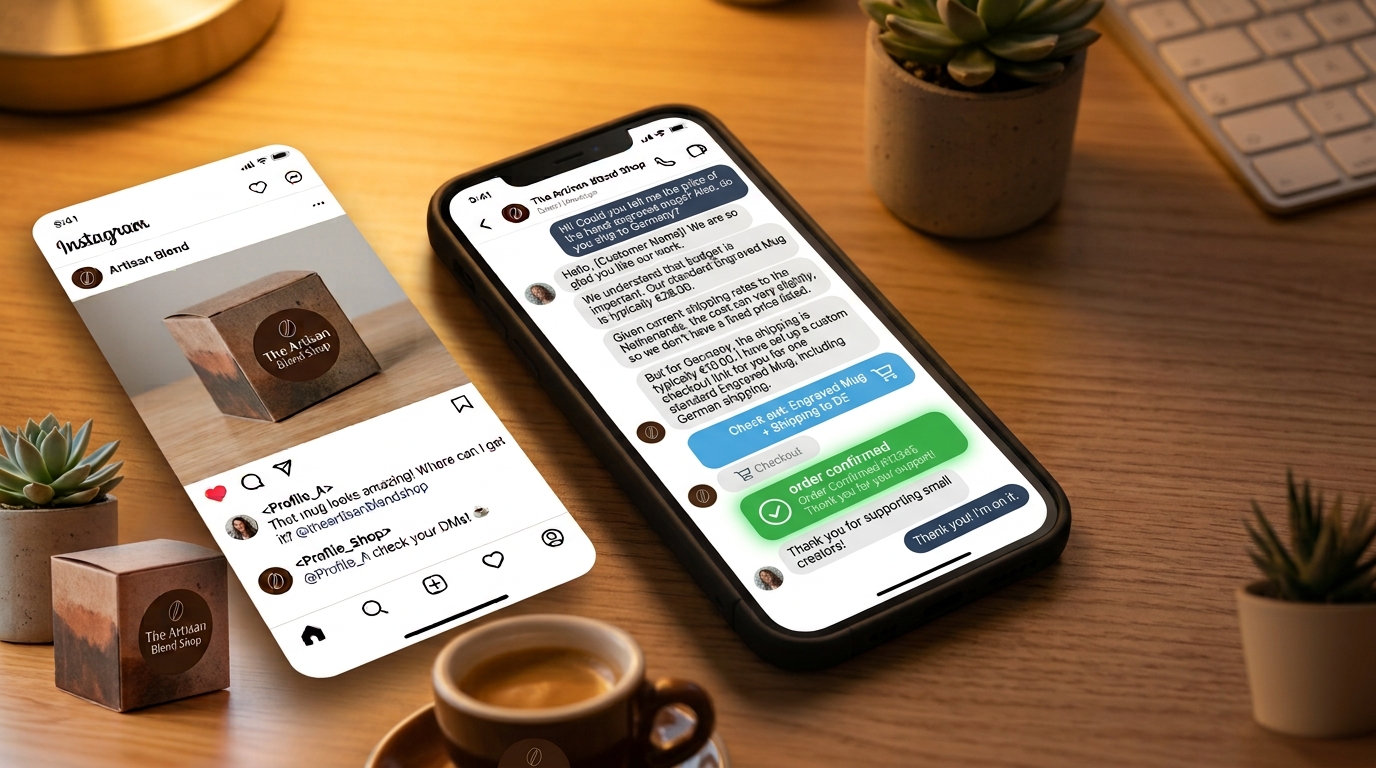
Instagram DMs are the highest-intent sales channel on the platform — and the one most brands manage worst. Replies are slow, follow-ups never happen, and warm buyers quietly disappear. The AI Sales Engine is the fix: a trained assistant that listens, qualifies, handles objections, closes and follows up, 24/7, in the DM.
This pillar guide is the complete playbook. It covers what the Sales Engine is, how it works at each stage of a sale, how to train it, how to keep a human in control, and how to measure the revenue it adds.
What an AI Sales Engine actually is
An AI Sales Engine is not a chatbot with canned replies. It is a sales assistant that understands intent and applies a real sales process. Where a traditional bot fires a keyword response, the Sales Engine:
- Reads the message and detects intent (price, objection, buy signal, FAQ).
- Replies in your brand voice, grounded in your real products and policies.
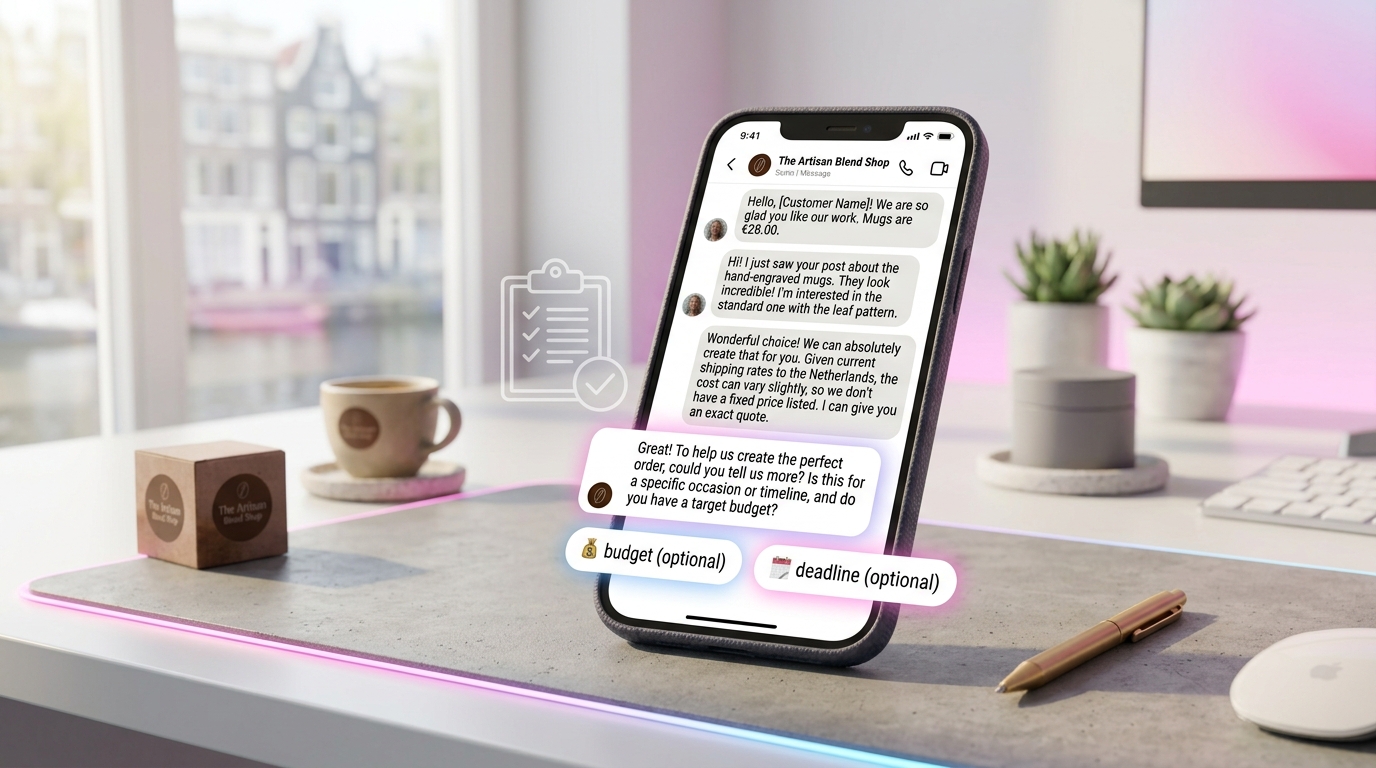
- Qualifies with the right questions and captures structured data.
- Handles objections with empathy and proof, not pressure.
- Recommends the right product for the situation.
- Closes with a checkout link or the next step.
- Follows up until the sale closes or the prospect opts out.
That is a full sales cycle — running in the chat, on the official Meta API, without you being online.
Why DMs close better than anything else on Instagram
Connect your Instagram and watch the first AI-handled conversation in minutes. 14-day free trial, no credit card.
Three reasons make the DM the strongest selling surface on the platform:
- Intent is highest. Someone who DMs you has already decided to talk. A like or a view is passive; a DM is active.
- It is private and personal. Trust is built one-to-one, away from public comments and competitors.
- It is conversational. You can qualify, object-handle and close in real time — like a sales call, but at scale.
The problem was never the channel; it was the capacity to answer every conversation. The Sales Engine removes that ceiling.
Stage 1 — Intent detection
Sell with the AI Sales Engine — full conversation
Play the prospect through a real qualifying conversation. The engine reads intent and sentiment, handles the objection and follows up.
Every message is first classified by intent. Typical intents:
- Price question — "how much?"
- Objection — "too expensive", "I need to think"
- Buy signal — "yes, send the link"
- FAQ — shipping, returns, hours
- Support — a problem to solve
Correct classification is what lets the engine respond appropriately instead of generically. It also drives routing: a buy signal triggers an alert, an objection enters the objection flow, an FAQ is answered from your documents.
Stage 2 — Qualification
Qualification is the difference between a busy inbox and a profitable one. The engine captures the signals that predict a sale:
- Need — what the prospect is trying to solve.
- Budget — the expected range.
- Deadline — how urgent it is.
- Fit — whether your offer matches.
These are stored as lead enrichment fields — structured data you can segment, retarget and report on. Qualification also protects your time: the engine politely parks leads that are not a fit, so you focus on the ones that are.
Read the dedicated guide on qualifying Instagram leads automatically.
Stage 3 — Objection handling (and the objection bank)
Objections are where most sales die. The engine handles the common ones with empathy and proof:
- Price — reframe around value and ROI, not discounts.
- Trust — social proof, guarantees, real examples.
- Timing — "I'll think about it" becomes a scheduled follow-up.
The most powerful feature is the objection bank: every objection the engine resolves is remembered with its winning reply. Over time, your agent gets measurably better at selling — without you writing new scripts. See how to handle objections in DMs.
Stage 4 — Recommendation
Armed with context, the engine recommends the right product. For e-commerce, it checks live stock and prices from a connected store and sends a product card. For services, it proposes the right package or next step. Recommendations are grounded in your real catalog — never invented.
Stage 5 — Closing
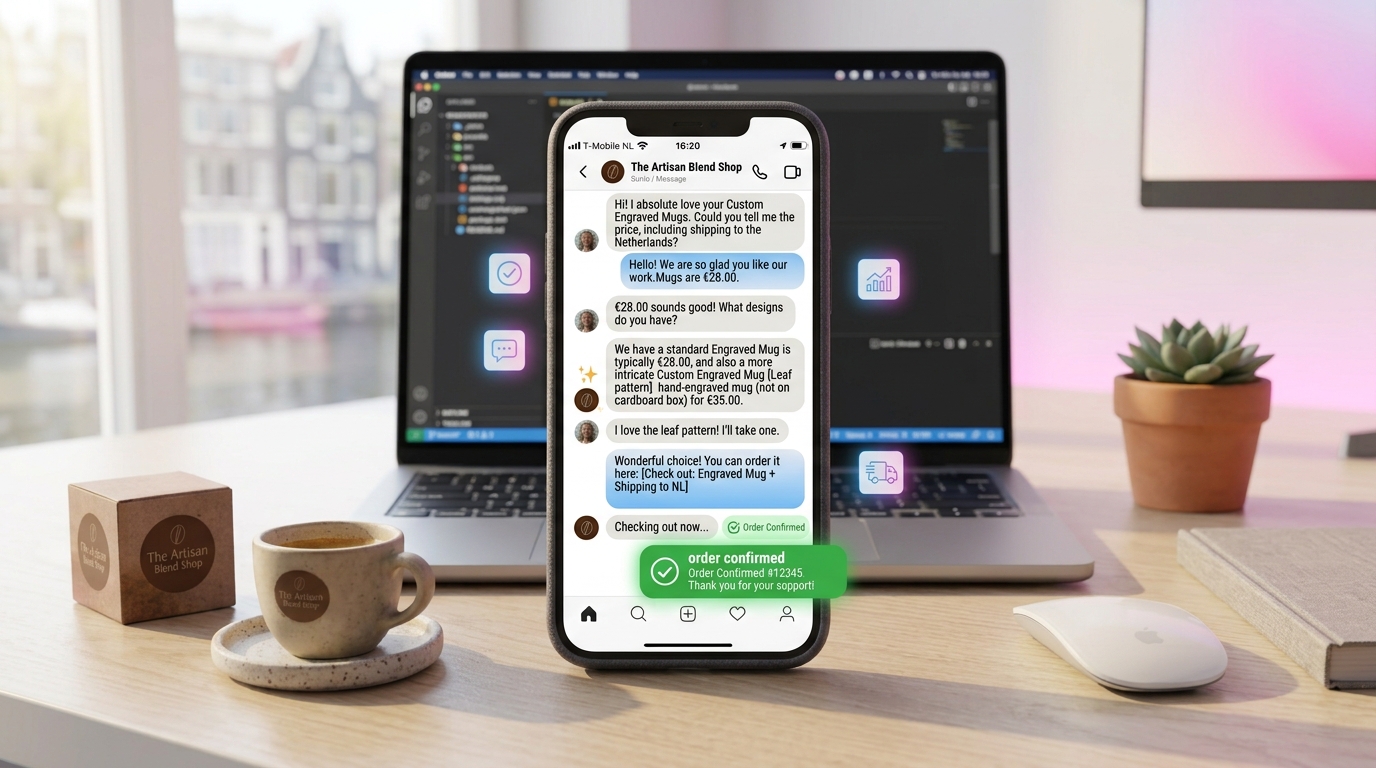
Closing is about removing friction. The engine drops a pre-filled cart or checkout link directly in the chat, so the buyer never leaves Instagram. For services, it books the call or shares a payment link, with all qualification data attached.
Stage 6 — Follow-ups
Most sales do not happen on message one. The engine schedules follow-ups at J+1, J+3 and J+7, each adding value rather than pressure. This alone recovers a large share of would-be lost sales. It also handles post-purchase flows: refill reminders, review requests and cross-sell.
Training your Sales Engine
The quality of the engine is the quality of its training. The essentials:
- Brand profile — products, prices, tone, policies.
- Documents (RAG) — FAQs, return policy, shipping info, so it never invents answers.
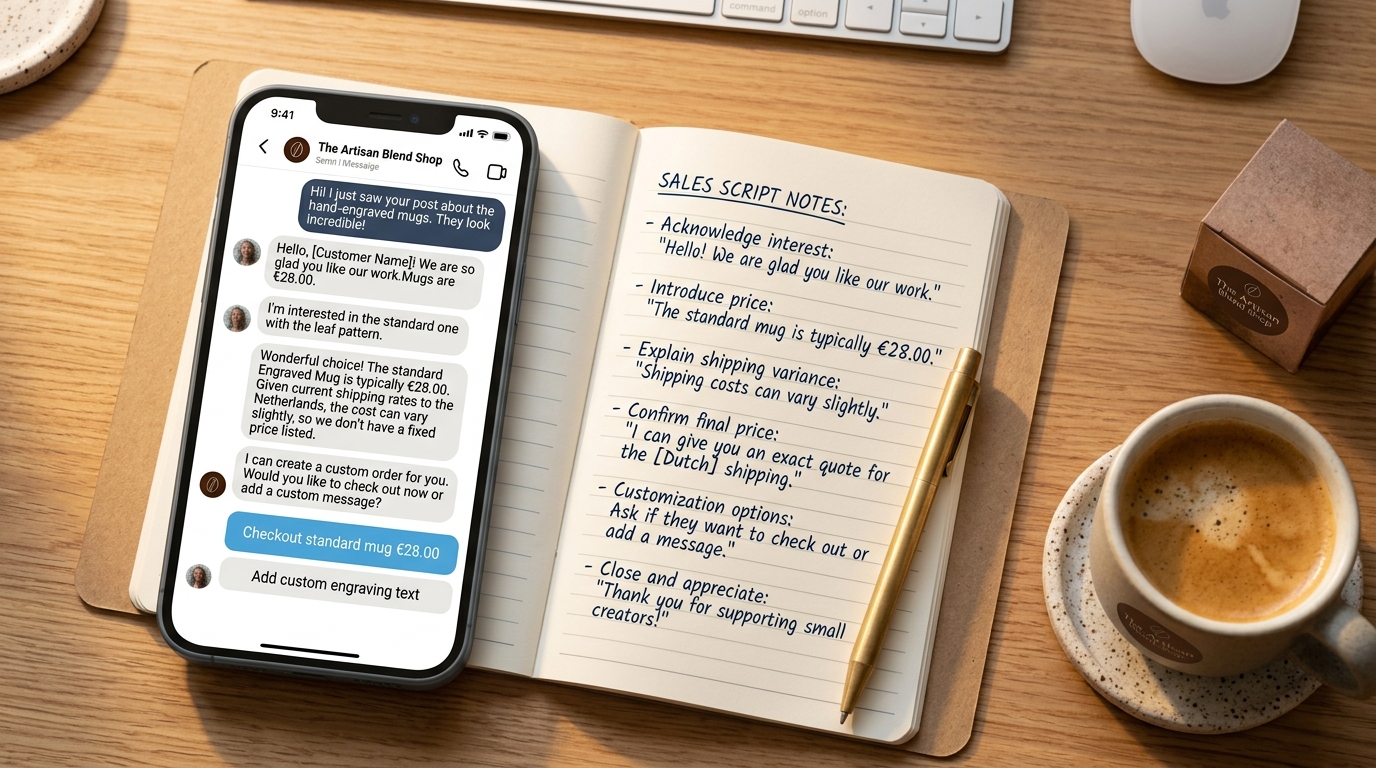
- Sales scripts — welcome, price, objection, follow-up.
- Qualification fields — what to capture per lead.
- Store connection — live stock and orders if you sell products.
For the full process, see how to train an Instagram AI chatbot on your brand.
Human-in-the-loop: never lose control
The Sales Engine is designed to work with you, not instead of you:
- AI handles the routine — FAQs, qualification, common objections.
- AI alerts you on buy signals and hot prospects.
- You confirm sensitive sends and take over high-value conversations.
This blend is what makes automation trustworthy: speed and scale from the AI, judgment and relationships from you.
Multilingual selling
The engine detects each prospect's language and replies in it automatically — 21 languages out of the box. This opens markets that manual support could never cover. See selling in multiple languages automatically.
Safety: why the official API matters
A sales engine is only worth it if your account stays safe. The engine runs entirely on the official Meta Graph API with OAuth — no password sharing, enforced messaging windows, and anti-ban protection. Dive into Instagram automation safety.
Measuring the Sales Engine
Track the metrics that prove revenue:
- DM reply rate — conversations answered.
- Conversation-to-lead rate — DMs that become qualified leads.
- Lead-to-sale rate — leads that convert.
- Revenue per flow — which workflow earns.
- Hours saved — the automation ROI.
A monthly ROI report turns this into a number you can show a team or a client.
Common mistakes to avoid
- Pitching too early. Qualify before you recommend.
- Ignoring follow-up. Most sales need 2–3 touches.
- Generic replies. Ground everything in your brand.
- No human handoff. Escalate the big moments.
- Unsafe tools. Always use the official API.
Getting started
Start with one flow: qualify a price question, handle your top objection, close with a link, and schedule a J+3 follow-up. Run it on the official Meta API, measure, then expand.
With GeniusInstaFlow, the full Sales Engine — listen, qualify, object-handle, close, follow up — runs 24/7 in 21 languages, without risking your account.
Want the wider strategy? Read the complete Instagram DM marketing guide.
A day in the life of the Sales Engine
To make it concrete, here is what a real day looks like when the engine is running:
- 02:14 — A prospect in another time zone asks about pricing. The engine answers, qualifies, and sends a checkout link. Sale closed while you slept.
- 08:30 — A buy-signal alert lands in your inbox: a hot lead wants a custom quote. You take over the conversation.
- 11:00 — A comment on your latest post triggers a DM; the engine qualifies and books a call.
- 15:00 — A J+3 follow-up goes out to yesterday's "still deciding" buyer. They convert.
- 19:45 — An objection about price is handled with proof; the prospect buys on the spot.
Not one of those conversations needed you to be at a keyboard. That is the leverage of a Sales Engine: it works the hours you cannot.
Qualification fields by industry
The fields you capture depend on what you sell. Here are starting sets:
- E-commerce: product interest, size/variant, budget, delivery deadline.
- B2B SaaS: company, role, team size, budget, timeline, current tool.
- Agency/services: problem, scope, budget, urgency.
- Coaching: goal, experience level, budget, preferred format.
- Local/restaurant: party size, date, dietary needs, contact.
These become structured lead data you can filter, export and retarget — the raw material of a real pipeline.
How the Sales Engine compares to a human closer
It is not either/or. Think of the engine as the first responder and the human as the specialist:
- Response time: engine wins — seconds, 24/7.
- Consistency: engine wins — the same quality every time.
- Scale: engine wins — hundreds of conversations at once.
- Complex negotiation: human wins.
- Relationship building: human wins.
- Emotional or crisis calls: human wins.
The best teams combine both: the engine does the volume, the human does the value.
Integrating the Sales Engine with your stack
The engine does not live in isolation. It connects to:
- Your store (Shopify, WooCommerce) for live stock and orders.
- Your CRM via outbound webhooks and Zapier/Make/HubSpot.
- Your documents for grounded FAQ answers (RAG).
- Your ads via click-to-DM and the Conversions API.
Read the Instagram ads guide for the advertising side.
Rollout plan: first 30 days
- Week 1 — connect, build brand profile, write 3 scripts.
- Week 2 — launch one qualifying flow and a J+3 follow-up.
- Week 3 — add objection handling and a checkout link.
- Week 4 — review revenue per flow, A/B test your best script.
By day 30 you have a measurable, self-improving sales system.
Frequently asked questions
Will customers know it is AI? Often yes, and that is fine when it is helpful and transparent. Many prefer instant, accurate answers.
Can it really close a sale? For clear, qualified buyers, yes — it recommends, handles the final objection and sends the checkout link. Complex deals escalate to you.
Is it safe for my account? Only on the official Meta API. Anything asking for your password is a risk.
How long until it pays off? Most accounts see recovered sales from follow-ups within the first week.
Do I need to write everything myself? No — it drafts from your brand profile and learns from what converts.
Sales Engine vs a traditional chatbot
The distinction matters. A traditional chatbot fires triggered replies: keyword → canned response. It does not understand intent, cannot qualify, and fails on any question it was not scripted for.
The Sales Engine understands. It reads context, adapts its reply, qualifies, handles objections and remembers each customer. The difference is like a script vs a salesperson — and it shows up directly in conversion.
The objection bank in practice
Here is a concrete example of how the objection bank compounds value:
- Week 1: A prospect says "it's too expensive." The engine uses your default script.
- Week 2: Ten more prospects say the same. The engine logs which replies led to a sale.
- Week 4: The engine now leads with the highest-converting reply automatically.
- Week 12: The engine handles price objections better than most new hires.
You did not write a single new script after week one. That is the compound effect of persistent memory.
Revenue attribution: knowing what works
Every flow run is logged end-to-end, so revenue is attributed to the exact flow and step that converted. You can answer questions like: which script closes best? Which follow-up recovers the most? Which product recommendation converts highest? Data like this turns sales from art into a repeatable system.
Handling refunds, support and edge cases
A Sales Engine is not only for new sales. It also:
- Answers support questions from your FAQ and policies.
- Handles refund and return requests by pointing to your policy or escalating.
- Books appointments and demos for services.
- Escalates anything sensitive to a human instantly.
This frees your inbox from repetitive work while keeping a human for what matters.
What to automate first (and what not to)
Automate the high-volume, low-judgment conversations first: FAQs, price requests, availability, qualification. These are 70–80% of your DMs and they follow predictable patterns.
Do not fully automate negotiation, complaints or anything emotional — let the engine detect these and escalate. The rule of thumb: automate the routine, flag the exceptions.
If you are unsure where to start, look at your last 50 DMs and count how many could have been answered from your FAQ. That number is your automation opportunity.
Scaling without hiring
The classic problem: growth means more DMs, which means more staff. The Sales Engine breaks that link. It answers hundreds of conversations at once, so growth in traffic does not require growth in headcount. You scale the conversation, not the payroll.
Conclusion
The AI Sales Engine turns the DM from a backlog into your best sales channel. It listens, qualifies, handles objections, closes and follows up — consistently, in your voice, in 21 languages, on the official Meta API.
Start with one flow, measure, and let it compound. That is how an inbox becomes a revenue engine.
Put this into practice
Build your first AI workflow in minutes — the Sales Engine, Flow Builder and multilingual templates are ready.